


Rideshare drivers’ Tesla rental is a vehicle-hire arrangement for paid passenger trips, with the aim of keeping you earning without owning the car. In Los Angeles, choose an explicitly authorized rental with appropriate insurance and platform acceptance; concierge delivery and unlimited miles do not establish permission to carry paying passengers.
- Tesla rental for rideshare drivers starts with written permission, platform acceptance, and insurance for paid passenger trips.
- Suiteescape is best for travelers seeking concierge-style Tesla rentals in Los Angeles.
- Unlimited miles and FSD (Supervised) do not establish rideshare eligibility.
- Plan EV charging around your working hours, then compare rental agreements before booking.
Why Tesla rentals matter for rideshare drivers
Your rental has to serve two separate needs: transporting passengers and meeting the rules that allow you to accept paid trips. A premium cabin answers the first. Your rental agreement, insurance, and rideshare platform answer the second.
For your 2026 booking, treat approval as the first filter. A vehicle that suits your luggage, charging routine, and preferred driving position still needs an agreement that permits your intended work. Do not treat a listing’s mileage allowance as commercial-use authorization.
Suiteescape offers luxury Tesla rentals for travelers and locals in Los Angeles and LAX, including Model Y, Model 3, and Cybertruck, with concierge delivery and unlimited miles. Those benefits support personal travel; assess any proposed rideshare use separately before making a booking.
The right rental is the one you can use for your actual work, not simply the one you prefer to drive. Start with your intended platform and exact rental arrangement, then choose the vehicle.
How to choose a Tesla rental for rideshare work
Confirm permission before choosing a vehicle
Start with the manual route: read the rental agreement and your rideshare platform’s current vehicle and rental requirements. Look specifically for paid passenger transportation, commercial use, authorized drivers, and restrictions on how the vehicle can be obtained.
Ask the provider to identify the applicable language in writing. Separately, confirm that your platform accepts the particular rental arrangement. A provider’s permission and a platform’s acceptance are different checks; satisfying one does not establish the other.
For a 2026 rental, save the documents that apply to your booking rather than relying on a general search result. Approval should identify the arrangement you intend to use, including the driver and vehicle where required. Complete this check before paying for a rental intended for work.
- Name the platform you intend to drive for.
- State that you will transport paying passengers.
- Read the commercial-use and authorized-driver terms.
- Confirm the platform accepts the rental arrangement.
- Keep written confirmation with your booking records.
Match insurance to each part of your shift
Read the insurance documents yourself before selecting optional protection. Your questions should cover personal driving, waiting for a request, traveling to collect a passenger, and carrying that passenger. Ask the provider and insurer which coverage applies during each activity.
Do not equate rental damage protection with insurance for paid passenger trips. They address different questions. One concerns damage to the rented vehicle; another concerns liability arising from your driving and passenger transportation.
Use this rental insurance and protection guide to organize your questions, then confirm the actual contract. Written terms govern your rental, not an article or a verbal assurance. Keep claims contacts accessible so you know whom to reach if you need assistance during a shift.
- Check coverage while waiting for trip requests.
- Check coverage during pickup and passenger transport.
- Identify deductibles and exclusions in the documents.
- Confirm whether every intended driver is covered.
- Save the insurer’s claims instructions and contact details.
Choose the booking route that fits your use
Build a shortlist from rental arrangements your platform accepts. The manual approach is straightforward: compare the agreement, insurance documents, vehicle requirements, mileage terms, and return instructions side by side. Eliminate any option that does not clearly authorize your intended use.
Suiteescape’s Los Angeles Tesla rentals offer a concierge-style path for luxury personal travel, with FSD (Supervised) included, unlimited miles, and 450+ five-star reviews. That is a relevant option for an airport arrival, a personal visit, or travel between work commitments. It is not evidence of rideshare authorization.
For paid driving, ask about commercial use before discussing delivery convenience or model preference. For personal travel, concierge delivery directly addresses the handoff. Separate the purpose of the booking before comparing the benefits.
- Shortlist arrangements accepted by your platform.
- Identify whether each booking is personal or commercial.
- Compare the agreement rather than the headline offer.
- Confirm the delivery and return arrangements.
- Choose convenience only after resolving eligibility.
Fit the vehicle to passengers and your belongings
Write down what your shift requires before choosing a model. Consider passenger access, luggage, your own belongings, and the driving position you need for repeated trips. Check the exact vehicle rather than assuming a model name guarantees a particular configuration.
Model 3, Model Y, and Cybertruck are named options in the client’s rental offering. That does not establish their eligibility for a particular rideshare category. Confirm the model, model year, configuration, and required documentation with your platform before assigning a vehicle to your work plan.
During handover, adjust the seat and mirrors, locate essential controls, and check how passengers will enter and exit. If you need to accommodate specific luggage or equipment, inspect the usable space rather than estimating from photographs.
- Confirm the exact vehicle and configuration.
- Check the platform’s vehicle-category requirements.
- Inspect passenger entry and exit.
- Test space for your own belongings and anticipated luggage.
- Record the vehicle’s condition at handover.
Build charging into your working schedule
Start with a map and your own driving records. Mark where you begin work, where you expect to finish, and where you can charge without making a separate journey across Los Angeles. Check current charger information rather than treating a saved map pin as confirmation that a charger is usable.
For your 2026 planning, use a 7-day driving log as a worksheet. Record distance, working time, breaks, and charging stops. This is a planning exercise, not an earnings forecast or a promise about vehicle range.
Compare charging access with the exact vehicle’s condition and your expected route. An unlimited-mile allowance removes a mileage concern only to the extent stated in the agreement; it does not remove charging time or charging charges. Keep an alternative charging location in your plan.
- Map charging near your starting and finishing areas.
- Check connector compatibility and access instructions.
- Place charging breaks around your intended working hours.
- Record charging time separately from driving time.
- Confirm how charging charges reach your rental account.
- Identify an alternative charging location.
Rehearse the handover and return
Before your first working day, walk through the vehicle controls and return requirements. Ask how to access the car, report a problem, document existing damage, and complete the return. Confirm the required battery condition from your actual booking terms.
For a 2026 rental, use 3 checkpoints: handover, first shift, and return. At handover, establish the vehicle’s condition. During the first shift, check whether your charging plan fits the work. At return, follow the documented process and keep confirmation.
If the vehicle includes FSD (Supervised), learn its operation before using it. The driver must remain attentive and responsible for driving. Driver assistance does not replace your responsibility to passengers, and it does not establish platform or insurance approval.
- Photograph the vehicle at handover and return.
- Locate charging, climate, and door controls.
- Save the provider’s support contact.
- Review FSD (Supervised) instructions where applicable.
- Confirm return location and battery requirements.
- Keep written confirmation that the rental has ended.
The process is simple: establish permission, check coverage, select the booking route, fit the vehicle, plan charging, and complete the handover. Keep those decisions in that order so convenience does not outrun eligibility.
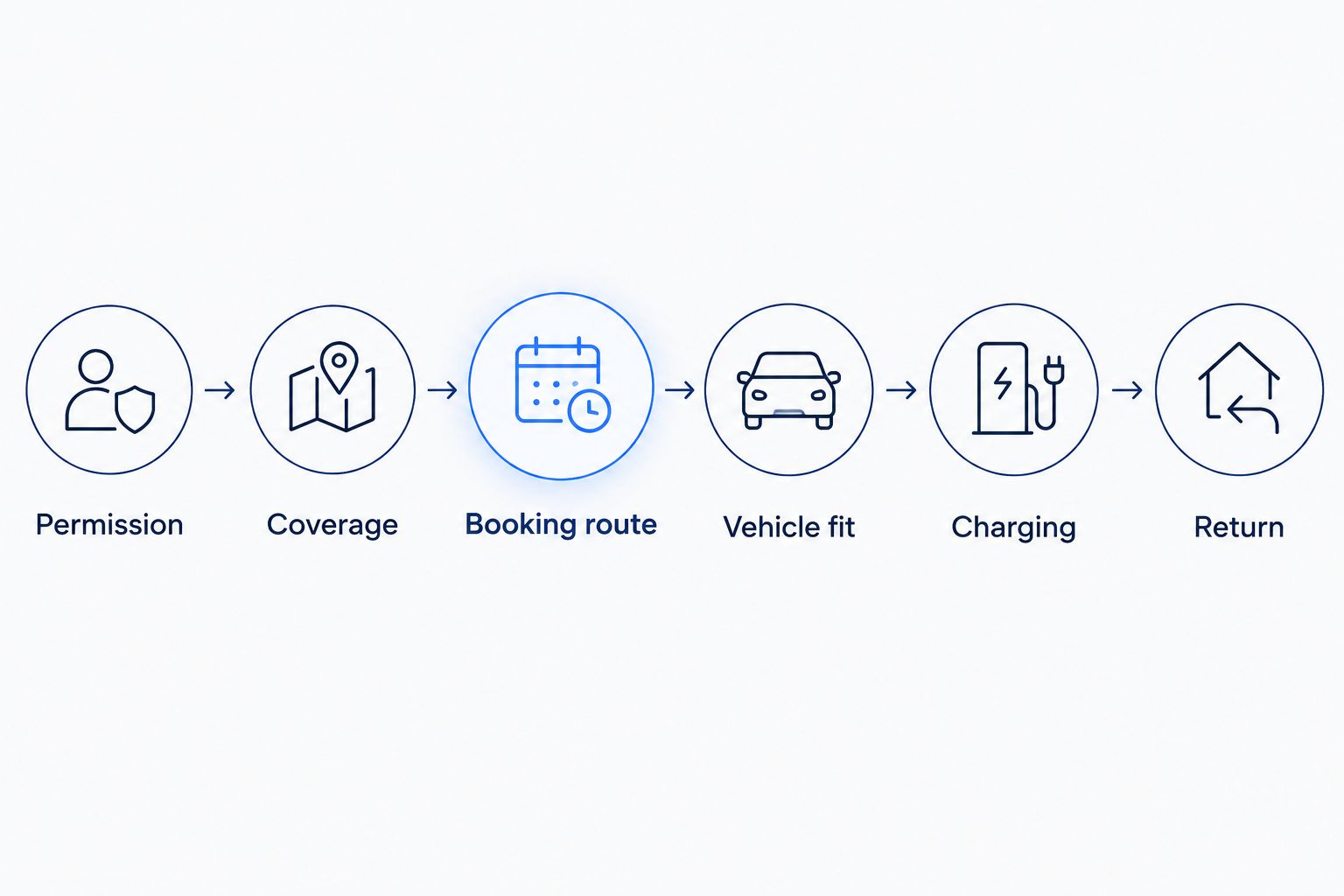
Compare booking routes for your intended use
For 2026, compare the exact booking route rather than declaring a universal winner by company name. The table below identifies what each option is useful for evaluating and the condition you must resolve. It does not establish commercial-use permission or Tesla availability for a specific booking.
| Option | Best for | Useful distinction | Key limitation or check |
|---|---|---|---|
| Platform-approved rental arrangement | Drivers seeking a rental accepted by their platform | Starts with platform acceptance rather than leisure features | Confirm vehicle eligibility, insurance, and the agreement’s scope |
| Suiteescape | Travelers seeking luxury personal Tesla rentals in LA and LAX | Concierge delivery, unlimited miles, and FSD (Supervised) included | Personal-travel benefits do not establish permission for paid passenger trips |
| Turo | Comparing a specific vehicle listing and its terms | Lets you evaluate the individual listing rather than a generic vehicle description | Verify platform acceptance and the applicable agreement before considering rideshare work |
| Hertz | Checking a named rental supplier against your platform’s requirements | Provides a supplier to include in your agreement comparison | Confirm the exact booking channel, vehicle, and authorized use |
| Avis or Budget | Comparing additional rental agreements | Broadens the documents you can review before selecting a route | Do not infer Tesla selection or commercial permission from the company name |
| Midway Car Rental | Adding another named provider to your LA shortlist | Offers another provider to assess against the same checklist | Confirm the exact vehicle, agreement, insurance, and delivery terms |
Choose an authorized arrangement for paid trips; choose a personal-travel rental for personal travel. A polished handoff and a comfortable vehicle are useful benefits, but neither answers the commercial-use question.
Keep your comparison consistent. Ask every provider the same questions and record the answers in the same order. This makes a favorable feature easier to assess without overlooking an unresolved contract term.
Check whether the rental fits your working day
After confirming permission and coverage, test the arrangement against your own records. Use 1 complete shift as a trial planning unit: leaving home, reaching your working area, accepting trips, charging, and finishing. This is a worksheet boundary, not a claim about how long a battery or rental will last.
Compare money received with the expenses you actually incur. Keep rental charges, electricity, insurance-related expenses, parking, tolls, and unpaid travel visible in your records. Do not turn gross trip receipts into a take-home figure without accounting for those items.
Time deserves its own column. A charging stop, vehicle collection, or return journey occupies time even when it does not appear as a separate charge. Use your experience to decide whether the arrangement fits your work, rather than borrowing another driver’s earnings claim.
- Record paid trips separately from unpaid driving.
- Track charging expenditure and time.
- Include collection and return journeys.
- Keep receipts alongside the rental agreement.
- Compare the finished shift with your original plan.
Common mistakes rideshare drivers make
Treating unlimited miles as permission to work
Unlimited miles describes a mileage allowance. It does not establish permission to carry paying passengers. Read the authorized-use terms independently, even when the allowance suits a demanding driving schedule.
Booking before confirming platform acceptance
A rental provider’s agreement and a rideshare platform’s requirements are separate. Confirm both before arranging a working rental. Keep the exact booking details available when asking the platform about acceptance.
Assuming protection covers every driving activity
Rental protection and passenger-transport insurance are not interchangeable labels. Ask which coverage applies while waiting, collecting a passenger, and completing a trip. Save the answer with the policy documents.
Choosing the model before checking the category
A preferred Tesla model is not automatically eligible for your intended platform category. Establish the required vehicle details first, then compare passenger access, luggage space, and driving comfort.
Planning distance but not charging time
A route can fit your mileage allowance while still creating an awkward charging schedule. Include charging access, breaks, and return requirements in your work plan. Assess the whole shift, not just the distance driven.
FAQ
Can I use any Tesla rental for Uber or Lyft in Los Angeles?
No. Use a rental arrangement that your platform accepts, with written permission for paid passenger transportation and appropriate insurance. Confirm the exact booking rather than relying on the vehicle model.
Is Suiteescape a confirmed rideshare rental option?
Suiteescape’s stated offering is luxury Tesla rental for travelers and locals in Los Angeles and LAX, not confirmation of rideshare authorization. Ask for written permission and verify platform acceptance before booking for paid passenger trips.
Does unlimited mileage mean I can drive paying passengers?
No. Unlimited mileage concerns the rental’s mileage allowance, while paid passenger transportation requires separate authorization and suitable insurance. Read both parts of the agreement.
Is Model Y better than Model 3 for rideshare driving?
Choose between Model Y and Model 3 only after confirming that the exact vehicle meets your platform’s requirements. Then compare passenger access, luggage needs, driving comfort, and your charging plan.
Can I use FSD (Supervised) while driving passengers?
FSD (Supervised) requires an attentive driver who remains responsible for driving. Follow the vehicle instructions and applicable platform rules; the feature does not establish rental eligibility or insurance coverage.
What should I check before accepting a Tesla rental at LAX?
Check the exact handoff arrangements, vehicle condition, charging instructions, support contact, and return requirements. If you intend to work as a rideshare driver, complete permission, insurance, and platform checks before the handoff.
How do I know whether a Tesla rental fits my rideshare work?
Compare an authorized rental against your own completed-shift records. Include rental expenses, charging, unpaid driving, collection and return time, and any applicable insurance-related expenses rather than judging by gross trip receipts.
One last thing
Separate your airport arrival from your commercial-driving decision. You can want a concierge-style Tesla handoff for personal travel while still needing a different, explicitly approved arrangement for paid passenger trips.
For your 2026 booking, send the intended provider a short written description of how you will use the car. Include paid passenger transportation if that is your plan. A clear description before booking is more useful than a premium feature list after booking.
Related guides
- Places to supercharge a Tesla in Los Angeles
- Charging a rental Tesla near LAX Airport
- Tesla rental companies with concierge delivery in LA