

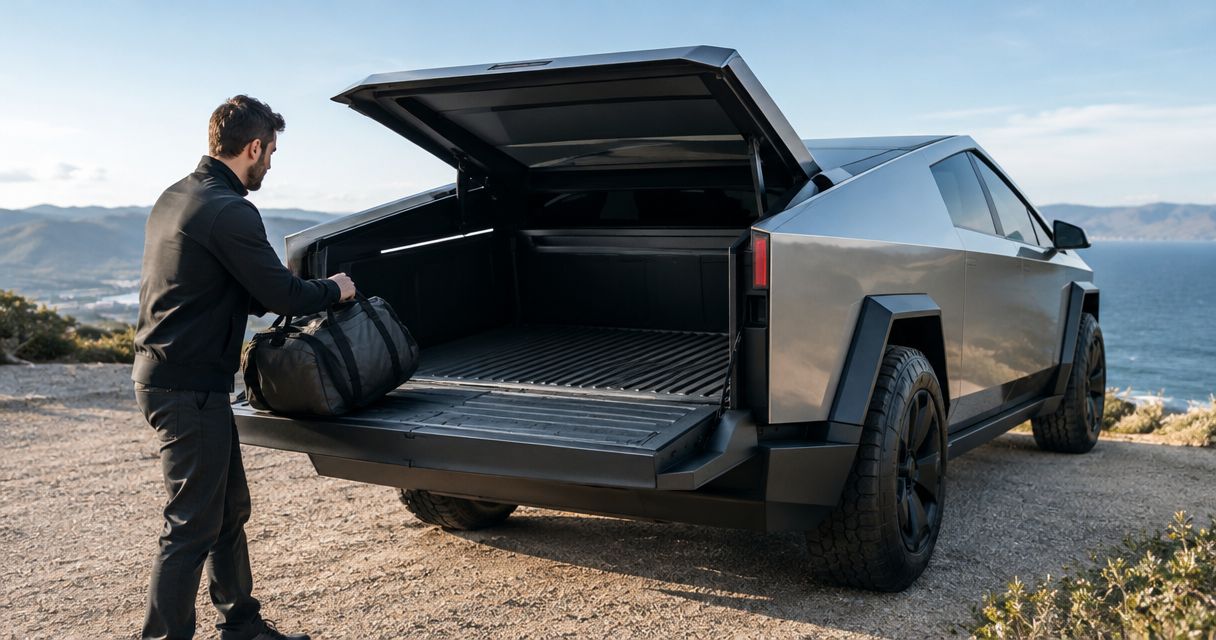
A rented Cybertruck has a 67-cubic-foot cargo bed, with a floor approximately 6 feet long and 4 feet wide, according to Tesla’s published specifications. That figure describes the bed, not a single combined luggage compartment, and it does not tell you how many suitcases will fit beneath the closed cover. For your 2026 trip, match your largest bags to the bed’s usable dimensions and confirm the actual rental’s configuration before booking.
- Cargo space in a rented Cybertruck includes a 67-cubic-foot bed; check luggage dimensions before booking.
- Tesla lists a bed approximately 6 feet long and 4 feet wide; cover clearance determines covered luggage fit.
- Suiteescape suits Los Angeles travelers seeking concierge Tesla rentals with unlimited miles.
- Keep travel essentials accessible and confirm the rental’s cargo configuration before your LAX arrival.
How much cargo space does a rented Cybertruck have?
Tesla lists 67 cubic feet of bed storage for the Cybertruck. Its published bed dimensions are approximately 6 feet long and 4 feet wide. Those measurements give you a useful starting point for luggage, outdoor equipment, and other travel cargo.
For 2026 planning, use Tesla’s published Cybertruck specifications for the headline capacity and the Cybertruck Owner’s Manual for loading guidance. The actual vehicle’s load label and rental agreement govern what you can carry. Cargo volume and permitted cargo weight are separate limits.
The Cybertruck also has a front trunk and cabin storage. Treat those as separate spaces rather than assuming the bed figure describes all storage throughout the vehicle.
| Storage area | Best for | Main advantage | Fit consideration |
|---|---|---|---|
| Cargo bed | Larger luggage and bulky travel equipment | Long, wide loading area | Check cover clearance and secure the load |
| Front trunk | Smaller bags and items you want separate | Separate from the rear bed | Confirm the opening and usable dimensions |
| Cabin storage | Essentials you need during the drive | Easy access for passengers | Keep seating and footwells clear |
Book for the shape of your luggage, not just the advertised cubic footage. A rigid case that is too tall for the closed cover does not become a good fit because unused space remains beside it.
Why this matters for an LAX arrival
You need your rental to fit the passengers and bags arriving on your flight—not an abstract amount of storage. Start with the largest suitcase, stroller, or equipment case, then work outward to smaller items. This keeps the pickup focused on loading and leaving.
Suiteescape is best for Los Angeles travelers seeking concierge Tesla rentals with unlimited miles. For a 2026 LAX trip, pair your delivery arrangements with a clear luggage list so the vehicle choice and loading plan support the same itinerary.
Keep passports, medication, charging cables, and your first-stop essentials accessible. Large cargo belongs in the designated storage areas; the things you need immediately should not disappear beneath the rest of your luggage.
Cybertruck cargo bed: 67 cubic feet
The 67-cubic-foot bed is the main reason to consider a Cybertruck when your trip includes bulky luggage. It gives you a dedicated cargo area outside the passenger cabin. You can plan around passenger comfort without treating an occupied seat as luggage storage.
The benefit is separation. Suitcases, outdoor gear, and other large items can travel in the bed while passengers retain their seating space. The trade-off is access: retrieving something from the bed requires a stop and an opportunity to open the cargo area.
A closed tonneau cover also introduces a height constraint. Check that every item sits clear of the cover’s path, rather than assuming that an open-bed loading arrangement will work once the cover closes.
Ask whether anything already occupies the rental’s bed. Accessories or equipment can reduce the space available for your bags, even though the vehicle’s published capacity remains unchanged. Plan around the vehicle you will receive, not a specification alone.
Cybertruck bed dimensions: approximately 6 feet by 4 feet
A bed approximately 6 feet long and 4 feet wide is useful for assessing long or broad items. Those measurements do not describe every contour, opening, or clearance within the cargo area. For rigid luggage, the narrowest relevant point matters more than the largest measurement.
Measure the full exterior of your largest item. Include wheels, handles, protective shells, and any parts that do not fold away. A suitcase’s named size is less useful than its actual outside dimensions.
For tall items, request confirmation of usable clearance beneath the closed cover. For long items, check both the bed length and the loading approach. An object must pass through the opening and settle into its intended position.
Do not plan a holiday rental around an open tailgate or uncovered overhanging load without explicit approval. A fully contained, secured load is the better starting point for travel luggage. It simplifies both the handoff and your stops along the route.
How many suitcases fit in a rented Cybertruck?
A 67-cubic-foot bed does not translate into one reliable suitcase count. Suitcases differ in exterior dimensions, rigidity, and shape, while handles and wheels create gaps between them. Stacking also depends on the closed cover’s clearance.
Make a luggage list by item rather than by passenger. Record each large suitcase, carry-on, stroller, and equipment case separately. Include bags you expect to add during the trip, not just those arriving at LAX.
Hard-sided cases provide predictable dimensions but leave less freedom to reshape the load. Soft-sided bags can fill irregular spaces, provided you do not compress fragile contents. Neither approach replaces checking the available height.
If your group has substantial luggage, send the rental provider a photograph and measurements of the largest pieces before booking. Ask for confirmation against the actual vehicle’s cargo configuration. That is more useful than a general promise that the truck has plenty of room.
Family luggage and strollers
Best for families: a loading plan that keeps large bags and folded equipment separate from passenger seating. Measure the stroller in its folded travel position and include any attached accessories that remain in place. Decide where the first-needed family bag will sit before loading everything else.
The bed’s size supports bulky-item planning, but a stroller’s shape still determines its fit. Avoid packing it beneath heavy cases or placing it where retrieving it requires unloading the entire cargo area.
Business travel and equipment cases
Best for business travelers: a confirmed fit for rigid cases, with work essentials kept accessible. Measure presentation equipment, camera cases, or other items you cannot repack. A protective case’s outside dimensions—not the equipment inside—determine the space it needs.
Keep laptops, documents, and anything you need at your first appointment within convenient reach. Check your organization’s requirements for transporting sensitive equipment and follow them throughout the trip.
Why usable Cybertruck cargo space varies
The headline capacity stays useful, but your packing result depends on the load. For a 2026 rental, resolve these details before choosing the vehicle:
- Bag shape: rigid cases leave gaps; flexible bags adapt more easily to the remaining space.
- Cover clearance: the load must fit beneath the tonneau cover if you intend to travel with it closed.
- Vehicle configuration: accessories or equipment already in the rental can occupy cargo space.
- Passenger needs: occupied seats and clear footwells take priority over extra cabin luggage.
- Access order: items needed at the first stop must remain reachable without a full unload.
- Load weight: passengers and cargo must stay within the actual vehicle’s permitted load.
Volume answers whether a load fits; the vehicle’s load limit answers whether you can carry it. Check both. A collection of compact, heavy cases presents a different loading problem from bulky, lightweight bags.
Plan your cargo before pickup
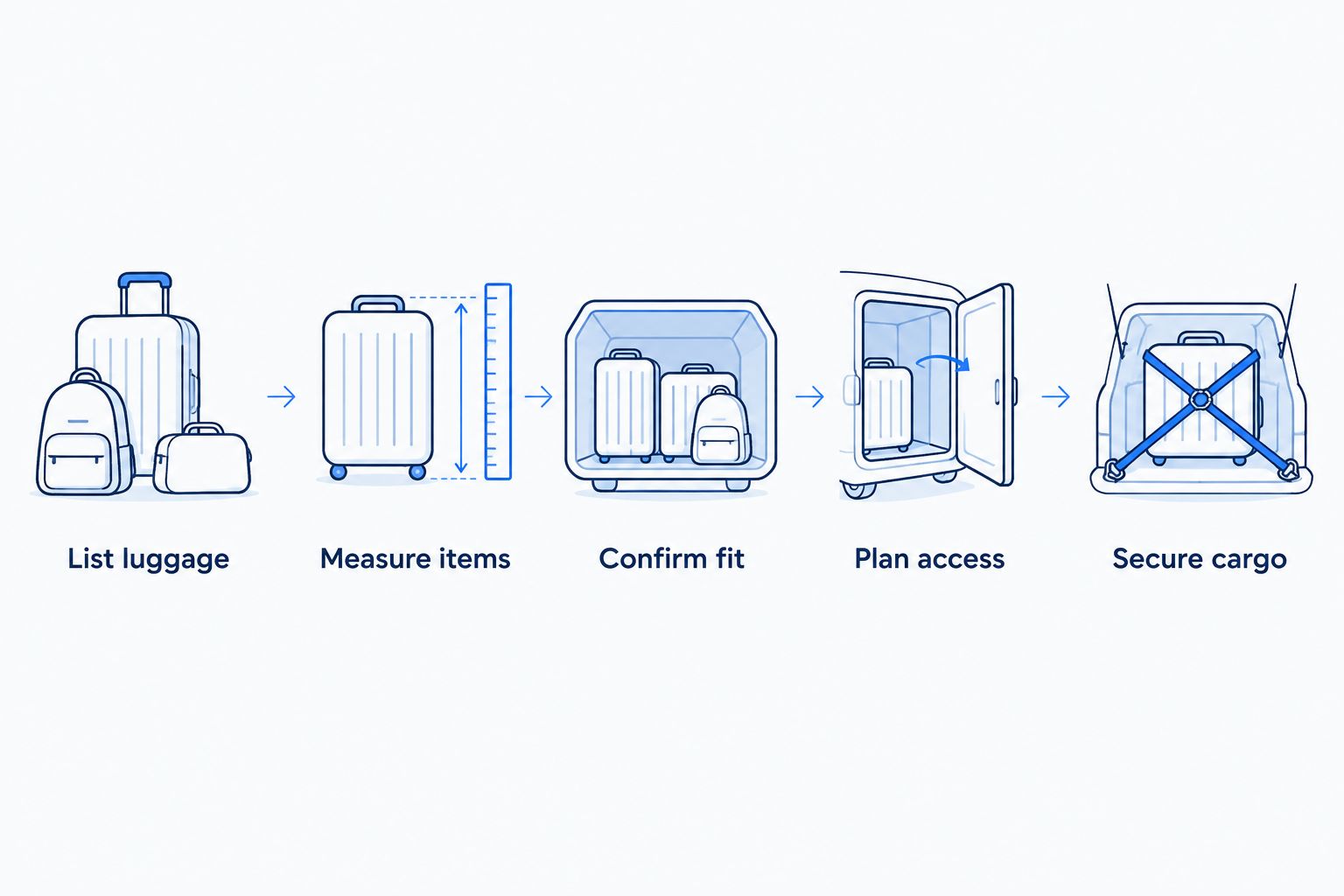
Use this sequence to turn the published dimensions into a practical loading plan. You do not need a perfect packing diagram; you need a clear answer about the largest items and the cover.
- List luggage. Include checked bags, carry-ons, folded equipment, and anything you will collect later.
- Measure items. Record the outside dimensions of rigid or unusually shaped pieces, including handles and wheels.
- Confirm fit. Ask the provider to confirm usable bed space, cover clearance, and any equipment occupying storage.
- Plan access. Decide which bag you need first and where essential documents and personal items will travel.
- Secure cargo. At pickup, follow the vehicle’s loading instructions and confirm that the load stays clear of the cover.
Before driving away, check the complete arrangement—not just whether everything went into the bed. Confirm that passengers have clear seating space, essential items are accessible, and the cover operates without contact with luggage.
What to confirm with your rental provider
For your 2026 reservation, send a short, specific message: your passenger list, luggage inventory, largest item dimensions, and intended pickup location. Ask whether the cargo area will be clear and whether your proposed arrangement fits beneath the closed cover.
Also confirm permitted use if you are carrying event equipment or anything beyond ordinary travel luggage. Cargo capacity is not permission for every type of load. The rental agreement remains the reference for how you use the vehicle.
Suiteescape’s Los Angeles Tesla rentals combine concierge delivery, unlimited miles, and FSD (Supervised) included, supported by 450+ five-star reviews. Those benefits suit airport arrivals and road trips; luggage fit still depends on your actual bags. FSD (Supervised) requires an attentive driver and does not make the vehicle autonomous.
Plan your Cybertruck rental
Share your luggage needs and arrange your Los Angeles Tesla rental.
Can you keep all passenger seats available with luggage in the bed?
The 67-cubic-foot bed gives you a separate place for luggage without using passenger seats. That is useful when everyone needs their seating position throughout the journey. Check the vehicle’s seating configuration and your full load before booking.
Keep passenger footwells clear rather than treating them as overflow storage. If the luggage arrangement depends on stacking bags around passengers, revisit the packing plan before pickup.
Does the cargo capacity change when you rent a Cybertruck?
The published 67-cubic-foot bed capacity does not change because the Cybertruck is rented. Your usable space changes if equipment occupies the bed or your luggage cannot use all of its contours. Confirm the delivered vehicle’s arrangement rather than relying solely on the model specification.
Rental terms also determine permitted use. A vehicle that physically accommodates an item is not automatically approved to transport it under your agreement.
Can you use a rented Cybertruck for a luggage-heavy road trip?
The 67-cubic-foot bed makes the Cybertruck worth considering for bulky road-trip luggage. Choose it when your measured cargo fits, the passengers have their required seats, and the loading arrangement allows access at planned stops.
For a 2026 itinerary, plan charging alongside the route and keep overnight essentials easy to retrieve. Unlimited miles addresses mileage allowance; it does not replace route planning or checking luggage fit.
FAQ
How much cargo space is in a rented Cybertruck?
A rented Cybertruck has a 67-cubic-foot cargo bed, according to Tesla’s published specifications. The front trunk and cabin storage are separate spaces; confirm the actual rental’s configuration before packing.
How long and wide is a Cybertruck’s cargo bed?
Tesla lists the Cybertruck bed as approximately 6 feet long and 4 feet wide. Check usable clearances and the loading opening for rigid or unusually shaped items.
How many suitcases can I put in a rented Cybertruck?
There is no reliable suitcase count without knowing your bags’ exterior dimensions. Measure wheels and handles, then confirm that the arrangement fits beneath the closed cover.
Can I close the Cybertruck’s bed cover over my luggage?
You can close the cover when your luggage fits beneath it and stays clear of its operating path. Confirm the available clearance and check the loaded arrangement before driving.
Is the Cybertruck’s cargo bed the same as total storage?
No, the 67-cubic-foot figure describes the cargo bed rather than one combined storage compartment. The front trunk and cabin storage have their own shapes and access points.
Can I carry heavy equipment in a rented Cybertruck?
Heavy equipment must comply with the actual vehicle’s load limit and the rental agreement. Check the vehicle’s load label and secure the cargo according to the owner’s manual.
Can I arrange a Cybertruck rental for a Los Angeles airport trip?
Suiteescape offers Cybertruck rentals with concierge delivery for travelers in Los Angeles and LAX. Confirm your delivery arrangements and luggage fit together before booking.
One last thing
Pack for the first bag you need to remove, not just the last bag you can fit. A well-planned load lets you reach a hotel bag or folded stroller without moving everything else. Choose that item first, then build the rest of the arrangement around its access.
The Cybertruck’s headline capacity helps you shortlist the vehicle. Your measurements, cover clearance, and loading order make it work for the trip.
Related guides
- Is curbside Tesla delivery available at LAX terminals?
- Is a Cybertruck rental worth it for a weekend in LA?
- Can you drive a rented Tesla from LA to Las Vegas?
- Connect Tesla Superchargers to your road-trip route planner



[…] room to open doors and unload luggage. If you plan to use the truck bed during the trip, review the rented Cybertruck cargo-space guide and consider where you will access your […]