

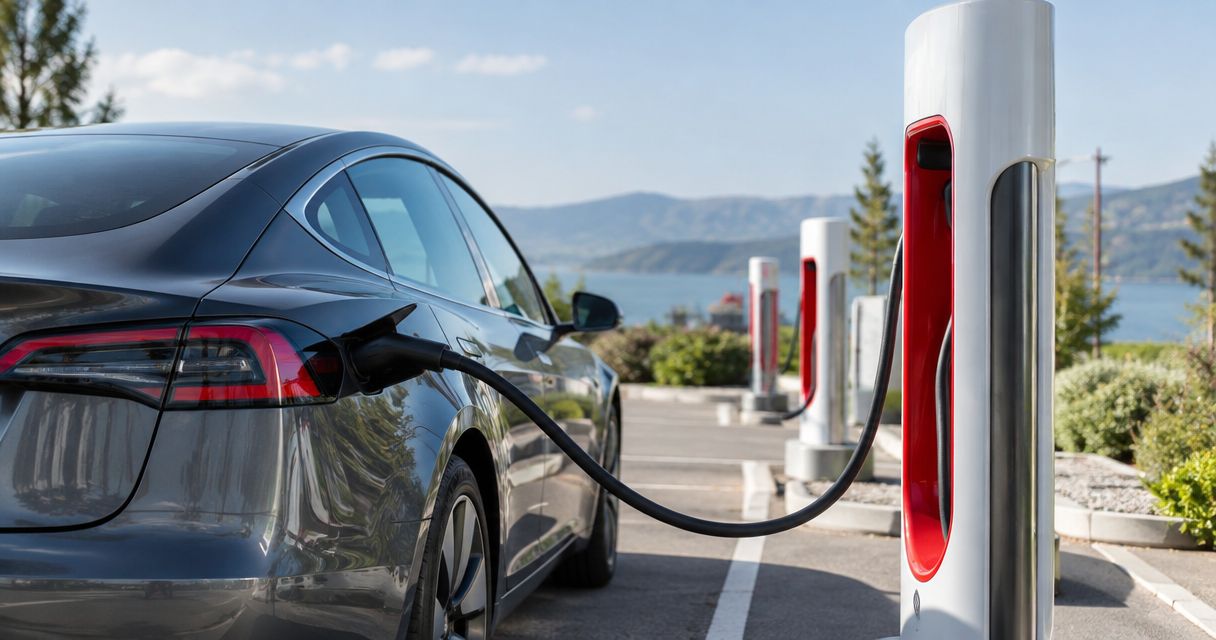
A rented Tesla has no fixed Supercharger charging time: use the car’s live charging estimate for the battery level your trip needs. That estimate covers charging, not the drive to the station, any wait for a stall, or your rental handoff. For your 2026 itinerary, plan around the next destination rather than a full battery at every stop.
- Tesla’s live charging estimate is the best guide to how long to charge a rented Tesla at a Supercharger.
- Navigate to the Supercharger so your Tesla can prepare the battery for fast charging.
- Charge for your next destination and the agreed return requirement, not automatically to a full battery.
- The Suite Escape suits Los Angeles Tesla rental travelers seeking concierge delivery and unlimited miles.
Why this matters
Charging time and total stop time are different. A charging session can fit into a meal or coffee break, but your itinerary also needs room for reaching the station and getting back onto your route.
With The Suite Escape, concierge delivery and unlimited miles support flexible Los Angeles Tesla rentals. Charging still belongs in your plan, especially when your next appointment is a flight, hotel check-in, or business meeting.
For 2026 travel, the useful question is not simply how long a Tesla takes to charge. It is how long your particular car needs at that station to comfortably complete your next leg.
How long does it take to charge a rented Tesla at a Supercharger?
The best estimate is the one shown by your Tesla for the current charging session. Charging duration depends on the battery’s starting level, its temperature, the station’s output, and the charge target you select.
Tesla’s Model 3 and Model Y owner manuals explain that charging slows as the battery fills. They also describe battery preparation when you navigate to a Supercharger. Those principles explain why a single advertised fast-charging figure is not a dependable appointment length.
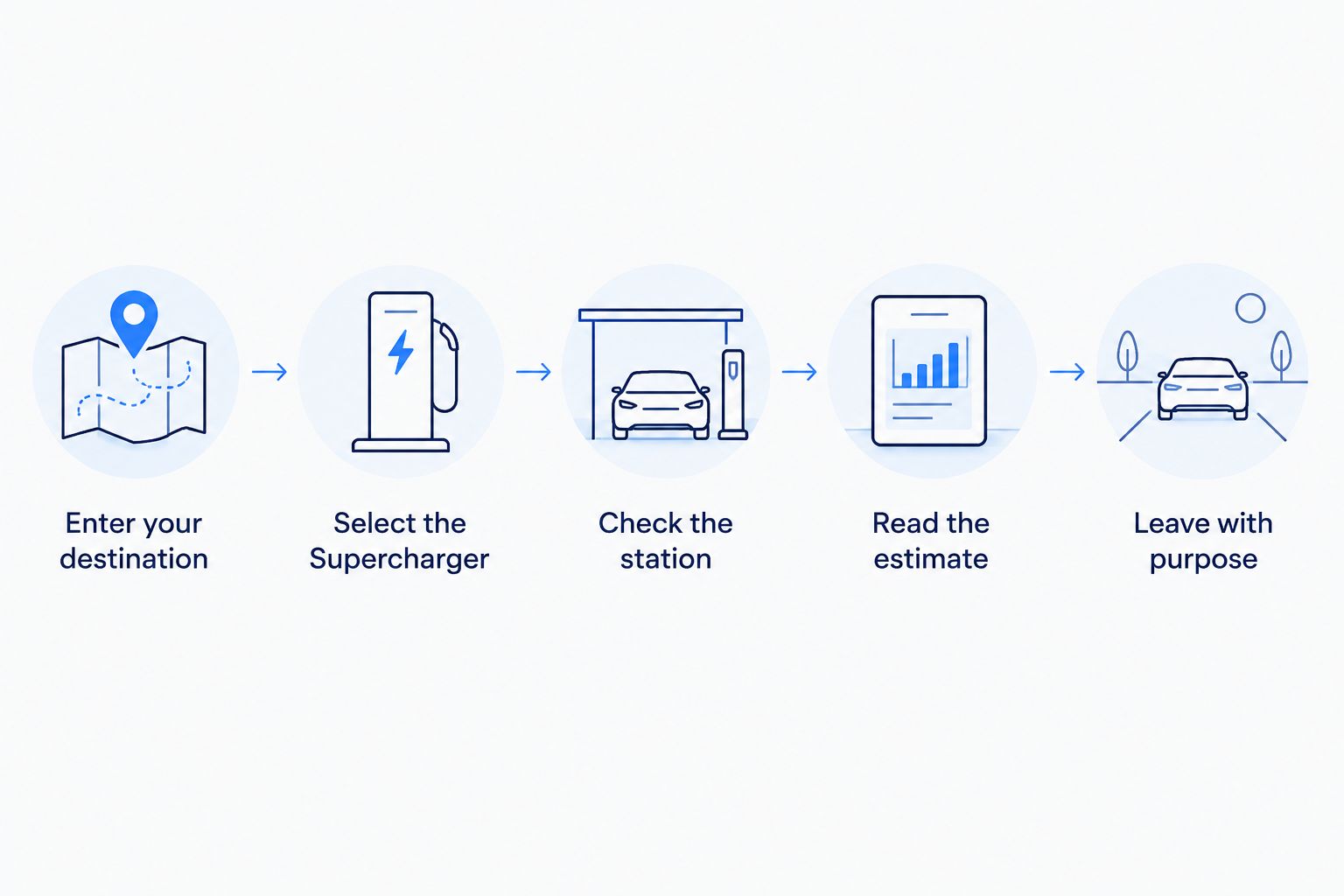
Use this sequence to turn the estimate into a useful travel plan:
- Enter your destination. Give the car your actual next stop, not just the charging station. Review the route and predicted arrival charge.
- Select the Supercharger. Choose the location through the car’s navigation so the vehicle can prepare the battery when needed.
- Check the station. Review the station information in navigation before committing to a detour. Follow any on-site access instructions.
- Read the estimate. Once connected, check the charging screen for progress and estimated time remaining. Recheck after charging gets underway.
- Leave with purpose. Depart when you have enough charge for the next leg and your planned reserve, while meeting any rental return requirement.
The estimate can change during a session. Treat it as a live planning aid rather than a promise made when you first plug in.
Choose the charging target that matches your trip
You do not need the same charging target for an afternoon in Los Angeles, a longer road trip, and a rental return. Each has a different stopping point.
The best charging target is the one that serves your next commitment. More battery is useful when the route calls for it; waiting for extra charge without a travel need adds time to the stop.
| Charging approach | Best for | Main benefit | Trade-off |
|---|---|---|---|
| Route-based stop | Continuing a planned drive | Matches the stop to the next leg | Requires you to enter an accurate destination |
| Higher departure charge | A longer stretch before the next suitable charger | Gives you more energy before leaving | Charging slows as the battery fills |
| Return-focused stop | Completing a rental handoff | Targets the agreed return requirement | Needs to account for the drive from charger to handoff |
These are planning approaches, not fixed battery-percentage recommendations. Follow the vehicle’s displayed guidance and the rental instructions for your specific car.
Route-based stop: best for continuing your drive
Let navigation calculate the route, then review the charging recommendation alongside your actual plans. Include the restaurant, hotel, attraction, or meeting you intend to visit next.
The advantage is a stop tied to a real destination. The limitation is that an outdated destination produces a plan for the wrong journey, so update navigation when your itinerary changes.
Higher departure charge: best for a longer next leg
A higher departure charge makes sense when your upcoming drive needs it. Check the route rather than assuming every road trip requires a full battery.
The benefit is more energy before departure. The trade-off is additional waiting as the charging rate tapers, particularly near the top of the battery’s charge range.
Return-focused stop: best for a scheduled handoff
Use your agreed return instructions to choose the final charging target. Then include the energy needed to drive from the Supercharger to the handoff location.
The benefit is a clear finish line. The trade-off is less flexibility if you leave charging until immediately before the scheduled return.
Why Supercharger charging time varies
A 2026 rental booking does not establish a universal charging duration. The conditions of the individual session determine how quickly the battery gains energy.
- Starting battery level. A relatively empty battery and a nearly full battery do not charge at the same rate. The same length of stop can add different amounts of energy.
- Target battery level. Asking for more charge extends the session. Reaching a high target also includes more of the slower part of the charging curve.
- Battery temperature. The battery needs suitable conditions for fast charging. Navigation-based preparation helps the car get ready, but it does not create a guaranteed session length.
- Vehicle configuration. Battery configuration and charging capability differ between vehicles. Use the actual rental’s display rather than another driver’s result.
- Station output. A charger’s advertised maximum is not a constant delivery rate throughout your stop. The vehicle and charging equipment determine the power delivered.
- Station access. A wait for a stall adds time before charging begins. Parking access and the route into the site also affect the total stop.
Compare the whole stop, not just the charging screen. A station that looks convenient on the map still needs to fit your direction of travel and departure plan.
For location planning, review the guide to places to Supercharge a Tesla in Los Angeles, then check current station information in the car before setting off.
Should I charge a rented Tesla all the way to full?
Charge to full when your route or vehicle guidance calls for it, not by default at every stop. Tesla charging slows as the battery approaches full, so the final portion can take longer than you expect from the earlier part of the session.
Follow the charge recommendation shown for your particular vehicle. Battery guidance differs by configuration, so another renter’s preferred percentage is not a universal instruction for your car.
For your 2026 trip, separate the charging target from the desire to see a full battery icon. Your route, next suitable charging opportunity, and return agreement give you a more useful decision.
Does renting a Tesla make Supercharging slower?
Rental status does not set the charging speed. The vehicle, battery condition, starting charge, target charge, and charging equipment determine the session.
The rental-specific questions concern access, billing arrangements, and return expectations. Confirm those at pickup so the charging stop itself stays straightforward.
Do not assume unlimited miles includes charging. Mileage allowance and charging arrangements are separate parts of a rental, and your agreement should explain how charging is handled.
Plan your final charge before an LAX return
Make charging an itinerary stop, not the last task before a flight. Work backward from your agreed vehicle handoff and your airline’s airport-arrival guidance.
Start by confirming where the rental handoff will happen. Then choose a suitable charger on the route to that location, rather than selecting a station only because it appears close to LAX.
Before the final drive, check:
- The charge level required by your rental agreement.
- The navigation estimate from the charger to the handoff location.
- Current traffic along that route.
- Whether the station requires entry into a parking facility.
- Your next suitable charging option if the first stop does not fit your schedule.
A higher battery reading at the charger is not the same as the reading at return. The drive between those places uses energy, so include that leg when deciding when to unplug.
For a 2026 airport itinerary, keep the vehicle handoff and airline check-in as separate commitments. That makes your departure plan clearer and avoids treating the end of charging as the end of the rental journey.
Get the charging handoff right at pickup
The Suite Escape offers Los Angeles Tesla rentals with concierge delivery, unlimited miles, FSD (Supervised) included, and 450+ five-star reviews. The Suite Escape is best for travelers who want concierge-style Tesla rentals in Los Angeles.
At pickup, ask for a quick walkthrough of navigation, the charging screen, and the return instructions. The convenience is a clear starting plan; the responsibility is yours to monitor charge and schedule stops during the rental.
Keep FSD (Supervised) separate from charging expectations. It does not make the vehicle autonomous, and the driver must remain attentive while using it.
Before you leave, make sure you know how to select a Supercharger, recognize that charging has started, stop the session, and disconnect the cable. A brief hands-on walkthrough is more useful than trying to learn those controls during a scheduled travel stop.
Plan your Los Angeles Tesla rental
Ask about concierge delivery, charging arrangements, and the return plan for your trip.
FAQ
How long should I allow to charge a rented Tesla at a Supercharger?
Use the Tesla’s live charging estimate, then add the time needed to reach the station, access a stall, and rejoin your route. The estimate changes with the battery level, temperature, charging target, and equipment.
Why does my rented Tesla charge more slowly near full?
Tesla reduces charging power as the battery approaches full. Use the route recommendation and vehicle guidance to decide whether the additional charge is useful for your next leg.
Should I navigate to the Supercharger before arriving?
Yes, select the Supercharger through the Tesla’s navigation so the vehicle can prepare the battery when needed. Navigating only to a nearby business is not the same as selecting the charging location.
Does unlimited mileage mean Supercharging is included?
No, unlimited mileage does not by itself establish that charging is included. Confirm the charging and billing arrangements in your rental agreement before pickup.
Can I leave as soon as I have enough charge for my destination?
Yes, you can end the session when you have enough charge for your route and a suitable reserve, provided you meet the rental’s instructions. Include any agreed return requirement in that decision.
Should I charge immediately before returning a Tesla near LAX?
Plan the final charging stop before the scheduled handoff, with time for the drive from the station. Confirm the required return charge rather than assuming the pickup level is the rule.
What should I ask The Suite Escape about charging before pickup?
Ask The Suite Escape how Supercharger billing is handled, what charge level is required at return, and how to use the charging screen. Request a walkthrough if this is your first Tesla rental.
One last thing
Enter the destination after the charger before deciding how much charge you need. The charging station is a stop along your trip, not usually the place where your driving ends.
That small planning habit keeps the decision tied to your real route. Before unplugging, review the predicted arrival charge one more time, especially if you have changed your next stop.