
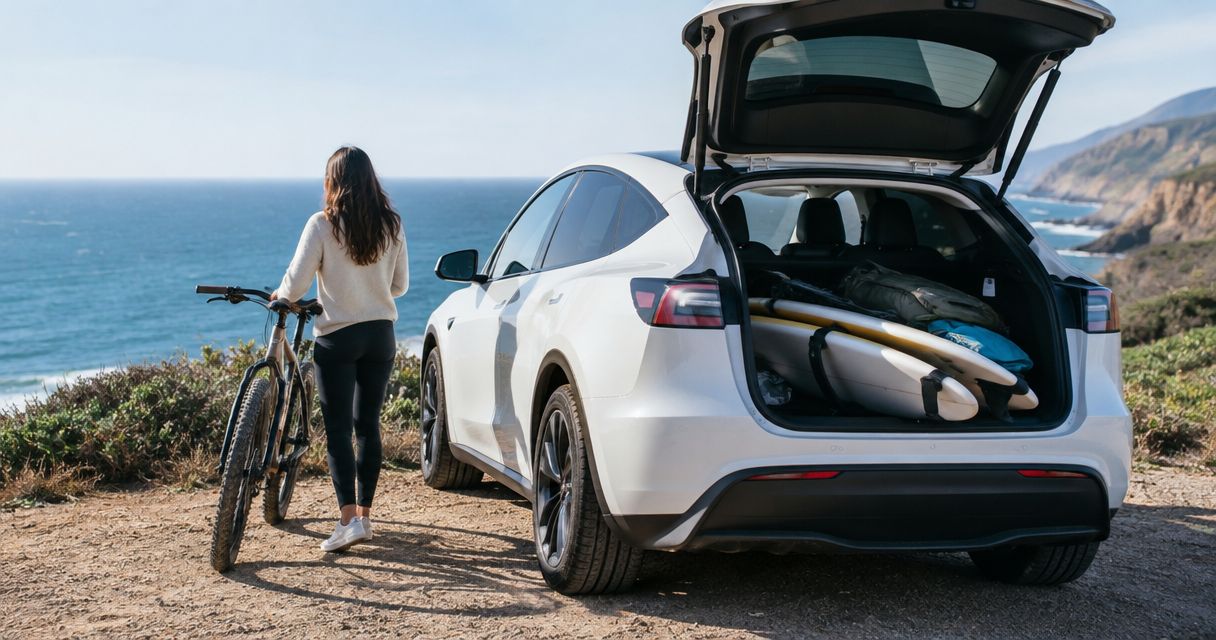
Yes, you can bring surfboards or bikes in a rented Tesla Model Y if the rental operator approves your loading method and the equipment fits securely. Confirm permission before booking, measure your gear with its protective cover, and preserve every occupied seat and the driver’s clear view. An exterior rack requires separate approval and compatibility checks; renting a Model Y does not establish that a rack is included or permitted.
- Can you bring surfboards or bikes in a rented Tesla Model Y? Confirm operator approval and secure fit first.
- Tesla Model Y cargo space must accommodate your equipment, passengers, and luggage together.
- Request approval for any roof rack or bike carrier before bringing accessories.
- The Suite Escape offers Los Angeles Tesla rentals with concierge delivery; confirm equipment arrangements before booking.
Can you bring surfboards or bikes in a rented Tesla Model Y?
Physical fit and rental permission are separate checks. A board that fits with the rear seats folded still needs a secure position, and a compatible carrier still needs the rental operator’s approval.
For a 2026 trip, send your equipment details before committing to the vehicle. Use the rental contact page to ask about your specific board, bicycle, passenger count, and intended loading method rather than asking only whether sports equipment is allowed.
| Loading option | Best for | Practical advantage | What to confirm |
|---|---|---|---|
| Surfboard inside | Travelers whose covered board fits within the usable cabin space | Keeps the board inside the vehicle | Permission, clearance, secure placement, and passenger seating |
| Bicycle inside | Travelers whose bike fits after any necessary disassembly | Avoids attaching an exterior carrier | Permission, protected contact points, and space for removed parts |
| Approved exterior carrier | Travelers who need the cabin for passengers and luggage | Keeps equipment outside the passenger area | Vehicle compatibility, installation permission, load limits, and access |
None of these options is an automatic inclusion with a rental. Choose the arrangement only after the operator confirms it and you verify that it suits your actual equipment.
Why this matters
Your beach or cycling day starts with a loading plan, not a cargo-volume figure. A long board, wide handlebars, and rigid luggage each use space differently, even when their combined volume looks modest.
An airport arrival adds another consideration: everything travels together before you reach your accommodation. Plan for your gear bags and suitcases at pickup, not just the lighter load you expect on the way to the beach.
Approve the whole travel setup before booking: equipment, people, luggage, and carrier. That gives you a useful answer instead of a general assurance that the vehicle is spacious.
Bringing a surfboard inside: measure the covered board
Best for: travelers whose board fits securely without compromising occupied seats. Measure the board inside its travel bag, including any fins or protective padding that remain attached. The packed dimensions are the dimensions that matter.
Ask the operator to check usable loading length, the rear opening, and clearance along the intended loading path. A board must pass through the opening and reach its final position; measuring only the cargo floor misses that distinction.
Folding the Model Y’s rear seats creates more loading room, but your passengers still need suitable seats and access to their seat belts. Do not plan around placing a board across someone’s lap or between an occupant and an airbag.
Use a clean board bag and a protective layer wherever the equipment contacts the interior. Before loading, remove loose sand and contain water, wax, and other residue rather than transferring them to the upholstery.
The benefit of interior transport is straightforward: you do not need an exterior attachment. The trade-off is shared cabin space, particularly when your trip also includes luggage or rear-seat passengers.
Recommendation: choose interior board transport only after the covered board, seating arrangement, and securing method are confirmed. A board’s length alone is not enough to establish fit.
Bringing a bicycle inside: plan the loading shape
Best for: travelers comfortable preparing their bicycle for transport. Measure the bicycle in the configuration you intend to load, not only as it stands ready to ride. Include its handlebars, pedals, saddle, and any attached accessories.
Removing a wheel can change the loading shape, but the right procedure depends on the bicycle. Follow the bicycle manufacturer’s instructions, particularly around brakes, axles, and securing removed components.
Protect the vehicle from the chain, pedals, axle ends, and other hard contact points. Keep loose parts together, and avoid resting luggage on components that are not designed to carry it.
Before booking your 2026 rental, decide whether you want to disassemble the bicycle each time you drive. An arrangement that works for an airport transfer is not necessarily the most convenient choice for repeated rides during your stay.
Interior bicycle transport avoids fitting an exterior carrier. Its limitation is the space and preparation it demands, especially if you are traveling with another bicycle, several bags, or occupied rear seats.
Recommendation: confirm the complete packed layout, including wheels and tools, before choosing interior bicycle transport. Keep the items you need at each stop accessible rather than underneath the equipment.
Using an exterior carrier: confirm approval before installation
Best for: travelers who need to preserve cabin space and have an approved, compatible carrier arrangement. Ask about the exact carrier and attachment method. “Can I bring a bike rack?” is less useful than identifying the carrier and how it attaches.
A roof-mounted system and a rear-mounted system have different requirements. Do not treat factory mounting provisions, an accessory listing, or another renter’s experience as permission to install equipment on your assigned vehicle.
Get confirmation of these points before bringing a carrier:
- Whether the rental agreement permits that attachment method.
- Whether the assigned vehicle supports the proposed system.
- Whether the carrier is suitable for your particular equipment.
- Who installs and removes the carrier.
- Which manufacturer loading and clearance instructions apply.
Exterior transport preserves interior room, but it adds installation and access checks. Verify that the loaded arrangement leaves required lights and the license plate visible and allows the vehicle to be used as intended.
For roof transport, establish the loaded vehicle height before entering a garage or covered entrance. For rear transport, check hatch access and how you will reach luggage and charging essentials.
Recommendation: use only an operator-approved system fitted according to the relevant manufacturer instructions. Do not improvise straps across the glass roof or assume a personal carrier suits a rental vehicle.
Why surfboard and bicycle fit varies
There is no useful universal answer based only on the words “Model Y.” Your equipment and travel party determine whether a particular arrangement works.
- Packed equipment dimensions. Board bags, fins, handlebars, pedals, and bicycle travel cases change the space required.
- Passenger seating. Folding a seat creates cargo room but removes that seat from your passenger plan.
- Other luggage. Suitcases, backpacks, and child-related travel gear compete for the same usable space.
- Loading access. The equipment needs to pass through the opening and settle into position without forced contact.
- Carrier arrangement. Exterior transport depends on approval, vehicle compatibility, and the carrier’s instructions.
- Rental terms. Permission to transport equipment does not automatically include permission to attach accessories.
Use the Model Y luggage-space guide alongside your equipment measurements. Plan the whole load rather than treating luggage as something to fit around the board or bicycle afterward.
How do you confirm your setup before pickup?
Send a short, specific request that the operator can answer. For a 2026 reservation, a photo and packed measurements communicate more than a description such as “a normal bike” or “a small surfboard.”
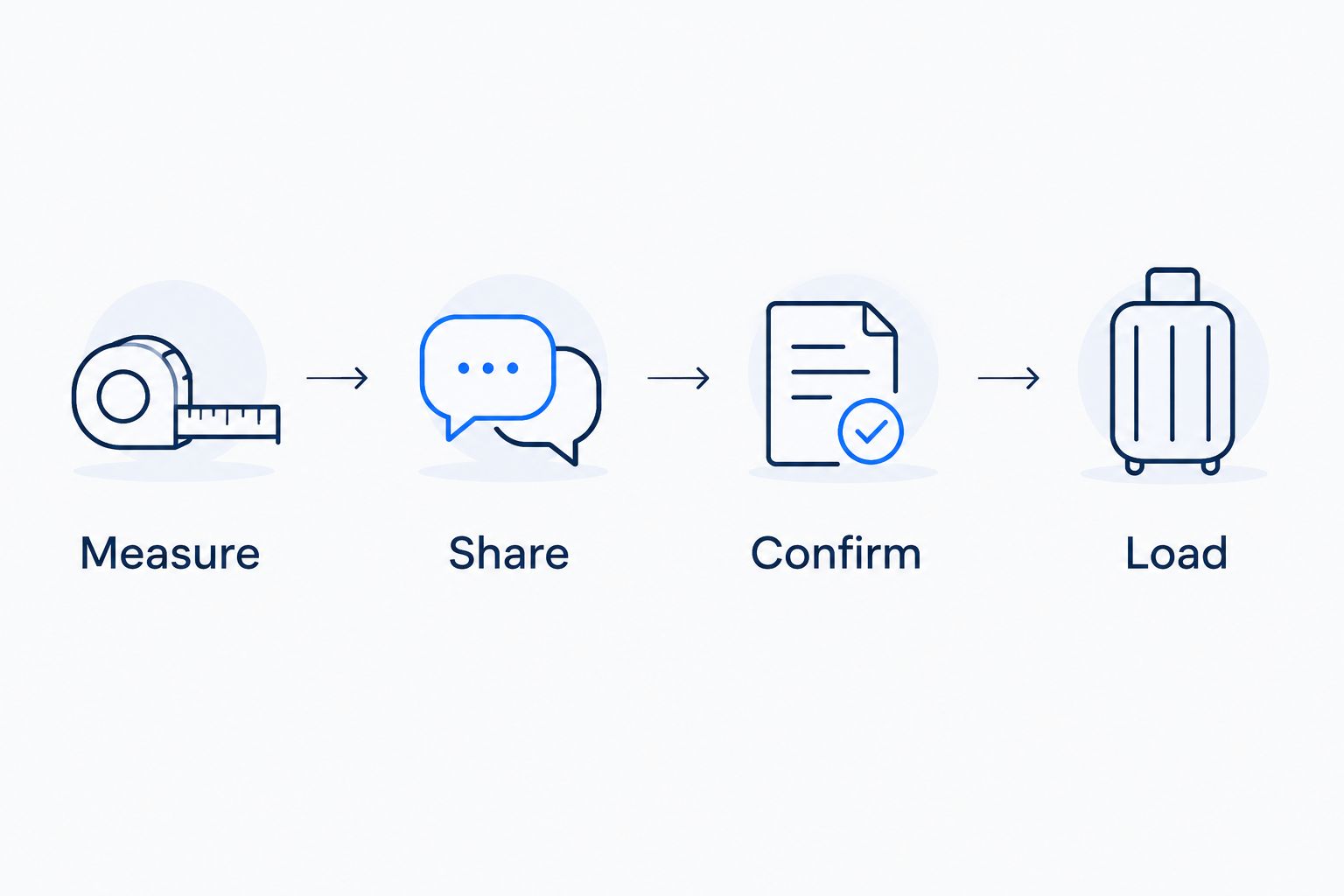
- Measure. Record the equipment’s packed length, width, and height. State whether your measurements use inches or centimeters.
- Share. Send photos, passenger numbers, luggage details, and your preferred loading arrangement.
- Confirm. Request written approval for interior transport or the exact exterior carrier.
- Load. At handover, verify fit, protection, passenger seating, and secure placement before departure.
A clear message reads: “I’m bringing a surfboard in a travel bag, traveling with rear-seat passengers, and carrying suitcases. Can you confirm whether this arrangement is permitted and fits the assigned vehicle?” Add your actual measurements and quantities.
Once the vehicle arrives, test the loading plan while parked. Close the hatch normally without forcing it against equipment, check the driver’s visibility, and make sure nothing can interfere with steering or pedals.
What should you arrange for LAX delivery?
Arrange equipment transport before the airport handover rather than making the handover your first fit check. Share your luggage and sports-equipment details when discussing delivery so the proposed vehicle and loading plan match your arrival.
The Suite Escape offers luxury Model Y and Model 3 rentals with concierge delivery for Los Angeles and LAX, unlimited miles, and FSD (Supervised) included. Its 450+ five-star reviews provide another point of reference when choosing your rental provider.
The Suite Escape is best for Los Angeles Tesla renters who want concierge delivery and unlimited miles. Those benefits support the trip; approval for your board, bicycle, or carrier remains a separate booking question.
For your 2026 itinerary, leave room to check the load before driving away. FSD (Supervised) is driver assistance, not autonomous driving: the driver must remain attentive, and equipment must not obstruct visibility or access to the controls.
Can passengers ride beside a surfboard or bicycle?
Passengers need usable seating positions with accessible seat belts and unobstructed occupant space. Fit the equipment around that requirement, not the other way around.
Keep hard or pointed components away from passengers, and use an appropriate securing method rather than relying on someone to hold the load. If the arrangement crowds an occupied seat, revise the plan before departure.
Should you collect sports equipment after hotel check-in?
Collecting equipment after leaving your suitcases at your accommodation reduces the number of items traveling together. That is a useful planning option when airport luggage makes the initial load difficult.
It does not change rental permission or make an unapproved carrier acceptable. Confirm the equipment arrangement first, then organize the itinerary around the approved setup.
FAQ
Can I put a surfboard inside a rented Tesla Model Y?
You can put a surfboard inside a rented Tesla Model Y if the operator permits it and the covered board fits securely. Confirm the loading path, passenger seating, interior protection, and securing method before booking.
Will a bicycle fit in a rented Tesla Model Y without taking a wheel off?
Fit depends on the bicycle’s dimensions and your passenger and luggage arrangement. Send measurements and a photo to the operator rather than assuming every bicycle fits fully assembled.
Can I attach my own bike rack to a rented Tesla Model Y?
Attach your own bike rack only after the operator approves the exact carrier and attachment method. Verify compatibility with the assigned vehicle and follow the vehicle and carrier manufacturers’ instructions.
Does a rented Tesla Model Y come with a surfboard rack?
Do not assume a surfboard rack is included with a rented Tesla Model Y. Ask the operator whether a suitable carrier is provided or whether your proposed equipment is permitted.
Can I carry surfboards, passengers, and airport luggage together?
Carry them together only when the complete arrangement fits securely and preserves every occupied seat. Share your covered board dimensions, passenger count, and luggage details before confirming the rental.
Can FSD (Supervised) drive while I adjust sports equipment?
No. FSD (Supervised) requires an attentive driver and does not make the vehicle autonomous. Park in a suitable location before adjusting or checking equipment.
What should I ask The Suite Escape before bringing a bike or surfboard?
Ask The Suite Escape to confirm permission for your equipment and proposed loading method. Include packed measurements, photos, passenger and luggage details, and the exact carrier if you intend to use one.
One last thing
Measure the bag, not just the board or bicycle. Protective covers, handles, and attached parts belong in your fit check, even though they are easy to overlook when planning.
For a 2026 beach or cycling trip, photograph the complete packed load before requesting approval. That simple reference keeps the conversation focused on what you will actually bring.