
Los Angeles Supercharger Network Guide for Tesla
Los Angeles rewards spontaneous plans: a sunset dinner in Malibu, a concert downtown, a morning meeting in Beverly Hills, then a late return toward LAX. This Los Angeles Supercharger network guide helps make those plans feel effortless rather than like a battery-management exercise. In a Tesla, the city is highly drivable. The difference is knowing when to charge, where to pause, and when the smartest move is simply letting the car plan the route.
Why Los Angeles Is Easy to Drive in a Tesla
Los Angeles County has a deep concentration of Superchargers, particularly around major retail corridors, freeway connectors, coastal neighborhoods, and travel routes leading out of town. That matters because LA trips rarely follow a neat loop. A day can stretch from Santa Monica to West Hollywood, through Los Feliz, and back to the airport without warning.
The practical advantage is not that a charger sits on every block. It is that a well-placed charge can cover a full day of flexible driving. Tesla navigation continuously considers battery level, terrain, traffic, and available charging stops, then builds charging into the route. For visitors, this is far more useful than trying to memorize a map before leaving the hotel.
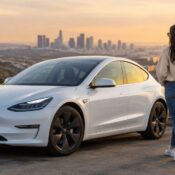
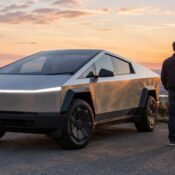
If you are renting a Model 3, Model Y, or Cybertruck, begin with the car’s navigation rather than a separate charging app. Enter your next destination, and let the vehicle suggest the best Supercharger stop if one is needed. The system can also show current station status and charging availability, though conditions can change quickly during busy travel windows.
Los Angeles Supercharger Network Guide: Where to Charge
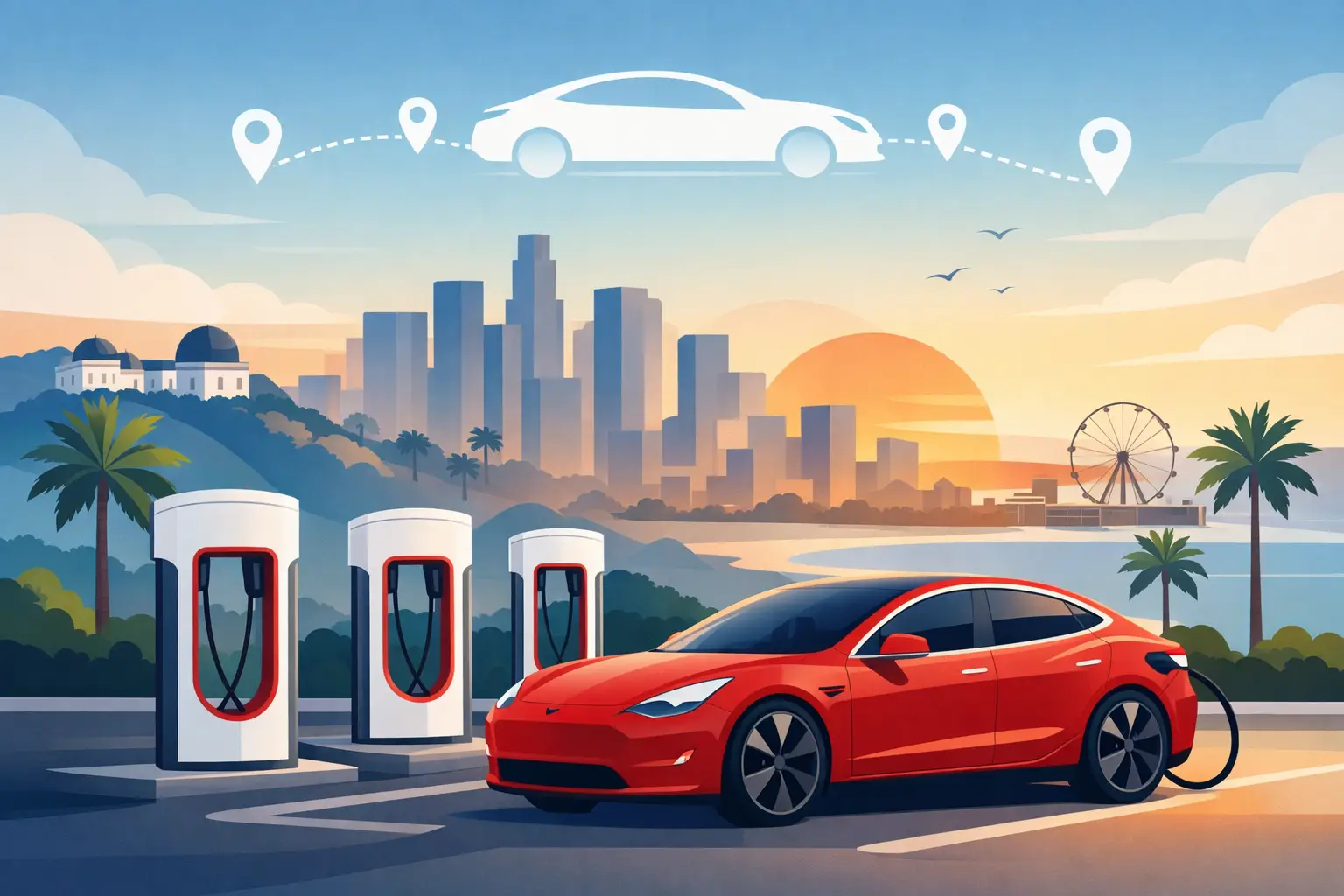
Think of the LA charging network in zones, not as a single list of stations. Your best option depends on where you will be parked, what time you are traveling, and whether your stop is a quick refill or part of the experience.
Near LAX and the beach cities
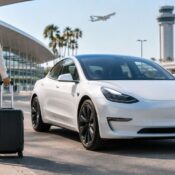
Airport-area charging is useful before an early departure, after a long arrival day, or when you are heading south toward Orange County. It can also be among the busier parts of the network, especially around holiday weekends and peak airport periods. If the vehicle has enough range for your planned evening, it may be more relaxing to charge after you have settled into your hotel or before your return rather than stopping immediately after landing.
For beach days, a Supercharger stop inland or near a larger shopping area can often be more efficient than looking for a charger directly on the sand. Charge before a long afternoon in Santa Monica, Venice, or Malibu, then enjoy the coast without keeping one eye on the battery display.
Westside, Beverly Hills, and West Hollywood
The Westside is ideal for pairing charging with something you already planned to do. A coffee, lunch, grocery stop, or a little shopping can turn a 15-to-30-minute charging session into time you barely notice. That is the sweet spot for Supercharging in Los Angeles: the car charges while your day continues.
These neighborhoods also see heavy traffic throughout the day. If navigation offers a charging stop slightly outside your immediate destination, take a moment to compare the expected arrival battery level with your actual plans. A short charge before entering a high-traffic area can be less stressful than hunting for one later.
Downtown, Hollywood, and central LA
Central LA provides strong coverage, but access details matter. Some Superchargers are located in garages, retail centers, or areas with specific entry patterns. Check the station notes on the Tesla screen before you arrive. They can clarify the parking level, access hours, validation requirements, or the most direct entrance.
Downtown is also a good place to charge before heading east, north, or south on a longer drive. If your plans include Pasadena, the San Gabriel Valley, Long Beach, or an evening event, topping up while you are already parked centrally can keep the rest of the trip simple.
Malibu, the Valley, and drives beyond the city
A coastal drive to Malibu is spectacular, but it is not the place to begin low on battery and hope for convenient options later. Charge before heading west, particularly if you plan to continue up the Pacific Coast Highway. The same principle applies to trips over the hills, through the Valley, or toward destinations such as Palm Springs, San Diego, or Santa Barbara.
For longer routes, Tesla navigation is the decision-maker. It will recommend charging stops based on the actual drive, not a generic range estimate. Follow the suggested stop unless you have a clear reason not to. Arriving with a comfortable reserve is more valuable than squeezing out a few extra miles between chargers.
How Much Charging Time Should You Plan?
For most LA days, a quick charging session is enough. Tesla batteries charge fastest at lower states of charge, which is why arriving around 15% to 30% and charging to roughly 80% is often efficient. The exact time depends on the vehicle, charger output, battery temperature, and how full the battery already is.
Charging from a low battery to 80% may fit comfortably into a meal or a shopping stop. Charging from 80% toward 100% takes longer, so it is usually best reserved for a long road trip or a situation where you truly need the added range. For local driving, you do not need to start every morning at 100% to have a great day.
There is one exception: return timing. If your rental instructions call for a particular battery level, plan your final charge with enough room for the drive to the return location. Charging to the requested level just before leaving, then adding freeway miles and airport traffic, can leave you short. A little buffer keeps the last hour of the trip polished and unhurried.
The Smart Way to Use Tesla Navigation
Tesla navigation does more than point you to an address. It estimates arrival charge, identifies Superchargers along the route, and can precondition the battery when a Supercharger is selected as the destination. Preconditioning prepares the battery for faster charging, especially when temperatures are cooler or the car has not been driven far.
Before leaving for a longer outing, enter the final destination into the vehicle. Do not wait until the battery feels low. Early routing gives the system time to make better recommendations and gives you more choice if a location is busy.
If you have synced your Tesla profile, the experience becomes even more personal. Navigation favorites, seat settings, mirrors, music preferences, and other compatible settings can be ready when you get in. It is a small detail, but it makes a rental feel less like borrowed transportation and more like your own car for the trip.
Charging Etiquette That Keeps the Network Moving
Supercharging is simple, but good etiquette matters in a city where stations can get busy. Park only in a charging space when you are actively charging. Once the car has reached the level you need, move it so the next driver can plug in.
Avoid blocking adjacent stalls, particularly at sites with shorter charging cables. Check the stall number and cable reach before parking, then use the space that lets the connector sit naturally without pulling or stretching it. If a station is crowded, the Tesla screen can help you see which stalls are operating and whether another nearby location may save time.
Idle fees may apply if a vehicle remains connected after charging is complete, depending on the station. Set a charging limit, keep notifications enabled, and treat the alert as your cue to wrap up your stop. A little awareness keeps the experience smooth for everyone.
Plan for LA Traffic, Not Just Mileage
Los Angeles range planning is shaped by time as much as distance. Freeway traffic can lower energy use compared with fast open-road driving, but steep hills, strong air conditioning, high speeds, and repeated short trips can shift the estimate. The Tesla’s range projection is useful because it responds to the route in front of you, not just a fixed number on a brochure.
For a day of city hopping, consider a relaxed charging rhythm: start with a comfortable battery level, add a brief charge around lunch or dinner if navigation suggests it, and avoid ending the night with a nearly empty battery. That approach leaves room for an unexpected detour, an upgraded dinner reservation, or one more stop along the coast.
Full Self-Driving can make freeway stretches and dense LA traffic feel more composed, but the driver remains responsible and must stay attentive at all times. Use the technology as support, not as a reason to disengage from the road.
A Better Final Charge Before You Return
The easiest return is planned backward. Check the requested charge level, enter the return destination into navigation, and identify a convenient Supercharger that leaves enough range for the final drive. If you are returning near LAX, allow extra time for traffic, rental logistics, and the occasional busy station.
Guests of The Suite Escape also have 24/7 support if a charging question comes up during the trip. That reassurance is especially valuable for first-time Tesla drivers, but the habit applies to every EV journey: ask early, plan lightly, and let the car do the math.
Los Angeles is a city built around motion. With a thoughtful charging stop folded into your plans, your Tesla becomes part of the getaway – ready for the next reservation, viewpoint, or open stretch of coast.