

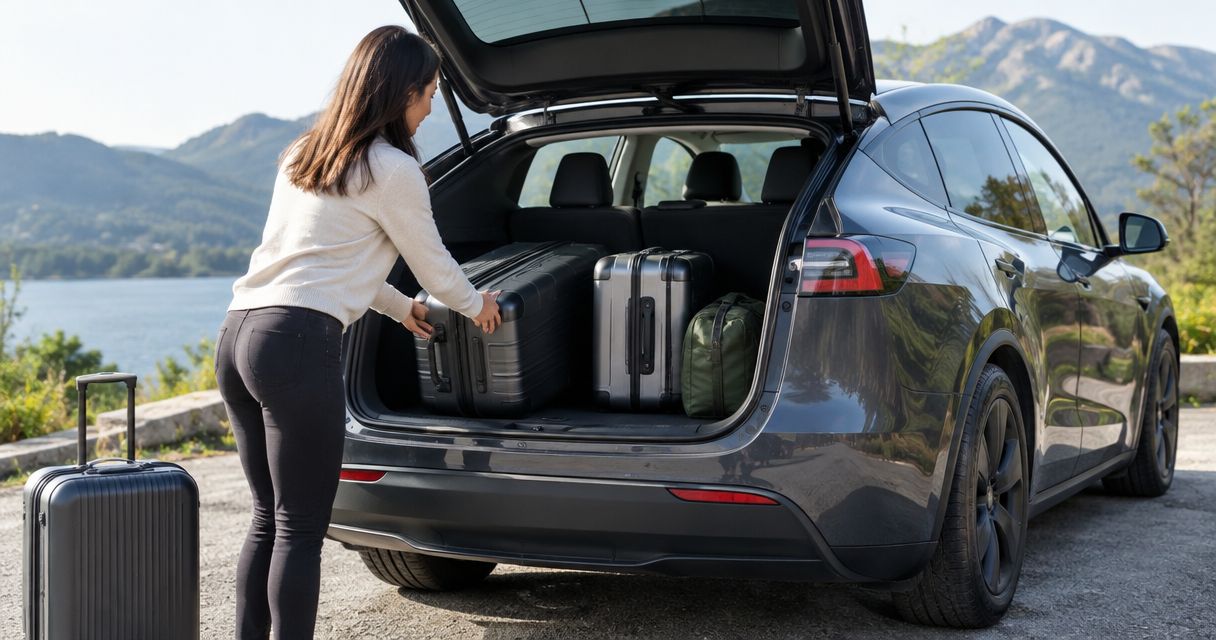
A rented Tesla Model Y carries luggage in its rear cargo area, front trunk, and underfloor storage; the number of suitcases that fits depends on bag dimensions and which passenger seats you need. Plan around the bags you are bringing, not a fixed suitcase count: a folded stroller, rigid cases, and occupied rear seats all change the usable layout.
- Tesla Model Y luggage space is 29 cu ft behind the rear seats, plus a 4.1 cu ft front trunk; with the rear seats folded, published capacity is 71–76 cu ft. Dimensions vary by model year, and suitcase fit still depends on bag shape, passenger seating, and stroller size—not suitcase labels alone.
- Keep passenger seats upright when checking family luggage fit; folded-seat cargo figures answer a different question.
- Use the front trunk and underfloor storage for appropriately sized bags, keeping arrival essentials accessible.
- The Suite Escape suits Los Angeles Tesla rental travelers who prioritize concierge delivery and unlimited miles.
How much luggage fits in a rented Tesla Model Y?
With the rear seats upright, a Tesla Model Y has a published 29 cu ft of rear cargo space, plus a 4.1 cu ft front trunk. With the rear seats folded, published total capacity is 71–76 cu ft. Dimensions vary by model year, so there is no universal suitcase count: a carry-on with a rigid shell uses space differently from a soft duffel, and the hatch opening matters just as much as the space behind it. Confirm the actual vehicle configuration and compare your packed luggage with the available loading area.
For your 2026 trip, start with the seating arrangement you will actually use. If passengers occupy the rear seats, treat the rear cargo area, front trunk, and accessible storage compartments as your packing zones. Do not plan around a photograph showing all the rear seats folded.
| Packing configuration | Best for | Main advantage | Main limitation |
|---|---|---|---|
| Rear seats upright | Families and groups using the rear seats | Preserves passenger seating | Large items must fit behind the occupied seats |
| Rear seats partly folded | Travelers with an unused rear seating position | Creates room for longer luggage | Requires checking passenger and child-seat placement |
| Rear seats folded | Travelers who do not need rear passenger seats | Opens a longer loading area | Removes those seats from passenger use |
| Front trunk and underfloor storage | Smaller bags and items that fit each compartment | Keeps the main cargo floor clearer | Separate openings limit the shape of items you can load |
The right luggage layout preserves every required passenger seat and lets the hatch close without pressing against your bags. A layout that works only after moving a passenger's belongings into their footwell is not a finished packing plan.
Why this matters for an LAX arrival
Your airport transfer starts with everyone and everything together: passengers, suitcases, personal items, and any family equipment. Check that full load before arranging your LAX Tesla delivery, rather than checking only the suitcases you expect to put in the trunk.
Concierge delivery simplifies the handoff. It does not change the dimensions of your luggage. Send the rental team a clear inventory so the vehicle discussion covers your actual trip, including a stroller or oversized item that a standard bag count leaves out.
Keep arrival essentials separate from the main stack. Your phone, identification, medication, and the bag you need at hotel check-in should remain easy to reach after loading.
Rear seats upright: plan around your passengers
For a family or business group, start with every required seat in its travel position. This gives you the relevant luggage layout before anyone begins rearranging the cabin.
Place your largest rigid bags in the rear cargo area first. Check their orientation against the opening, then consider where smaller bags fit without obstructing the hatch or interfering with passenger space. Do not assume a case fits simply because its base sits on the cargo floor.
The upper part of a suitcase matters, too. A tall case placed upright needs clearance where the hatch closes; laying it flat changes the footprint and leaves a different space for the next bag.
Best for: travelers who need rear passenger seating throughout the journey. The benefit is a consistent cabin layout; the trade-off is less flexibility for long or bulky luggage.
Rear seats folded: useful only when those seats are unused
Folding an unused rear seat creates a longer loading area. That helps with an elongated bag or another item whose shape makes it awkward to place entirely behind the rear seats.
Passenger planning comes first. Confirm which seats remain available, where any child restraint belongs, and whether the luggage can stay secure without intruding into an occupied position. Never treat an occupied seat as optional space.
Check the return journey as carefully as the arrival. If someone joins your group later, a layout built around folded seats needs to work again with those seats upright.
Best for: travelers with genuinely unused rear seats and longer items. The advantage is loading flexibility; the limitation is that you cannot use the same space for a passenger and cargo simultaneously.
Front trunk and underfloor storage: fit smaller items separately
The front trunk and rear underfloor compartment give you additional places to organize luggage. Treat each as its own shaped compartment, not as an extension of the main cargo floor.
A soft bag can adapt to an irregular space more readily than a rigid suitcase. However, its packed shape still needs to fit beneath the compartment lid without pressure. Check the bag when full, not when empty.
Decide which items you need during the drive before filling the main trunk. Underfloor storage is less convenient when another suitcase sits above its cover, so put less frequently needed belongings there.
Best for: smaller bags that fit the individual compartments. The benefit is a clearer main cargo area; the limitation is access when other luggage covers a storage opening.
Why Tesla Model Y rental luggage space varies
Your 2026 packing plan should account for these factors rather than relying on a single cargo-volume headline:
- Passenger seating: seats needed by travelers cannot become luggage space. Confirm the occupied positions before discussing folded-seat capacity.
- Bag dimensions: length, width, and height determine fit. Include wheels, handles, and expanded compartments in your measurements.
- Bag construction: a rigid shell keeps its shape; a soft bag changes shape only when its contents allow it.
- Bulky equipment: a folded stroller or equipment case changes the remaining space even when your suitcase count stays the same.
- Loading access: an item must pass through the opening and allow the hatch or compartment lid to close normally.
- Vehicle configuration: confirm the actual rental's seating and storage layout instead of transferring assumptions from another Model Y.
These factors interact. A flexible duffel helps fill an awkward gap, but it does not solve a stroller that cannot pass through the available opening. Address the largest, least flexible item first.
Check your luggage fit before you book
Use this sequence when arranging a 2026 rental. It turns a vague question about trunk size into a clear conversation about your passengers and belongings.
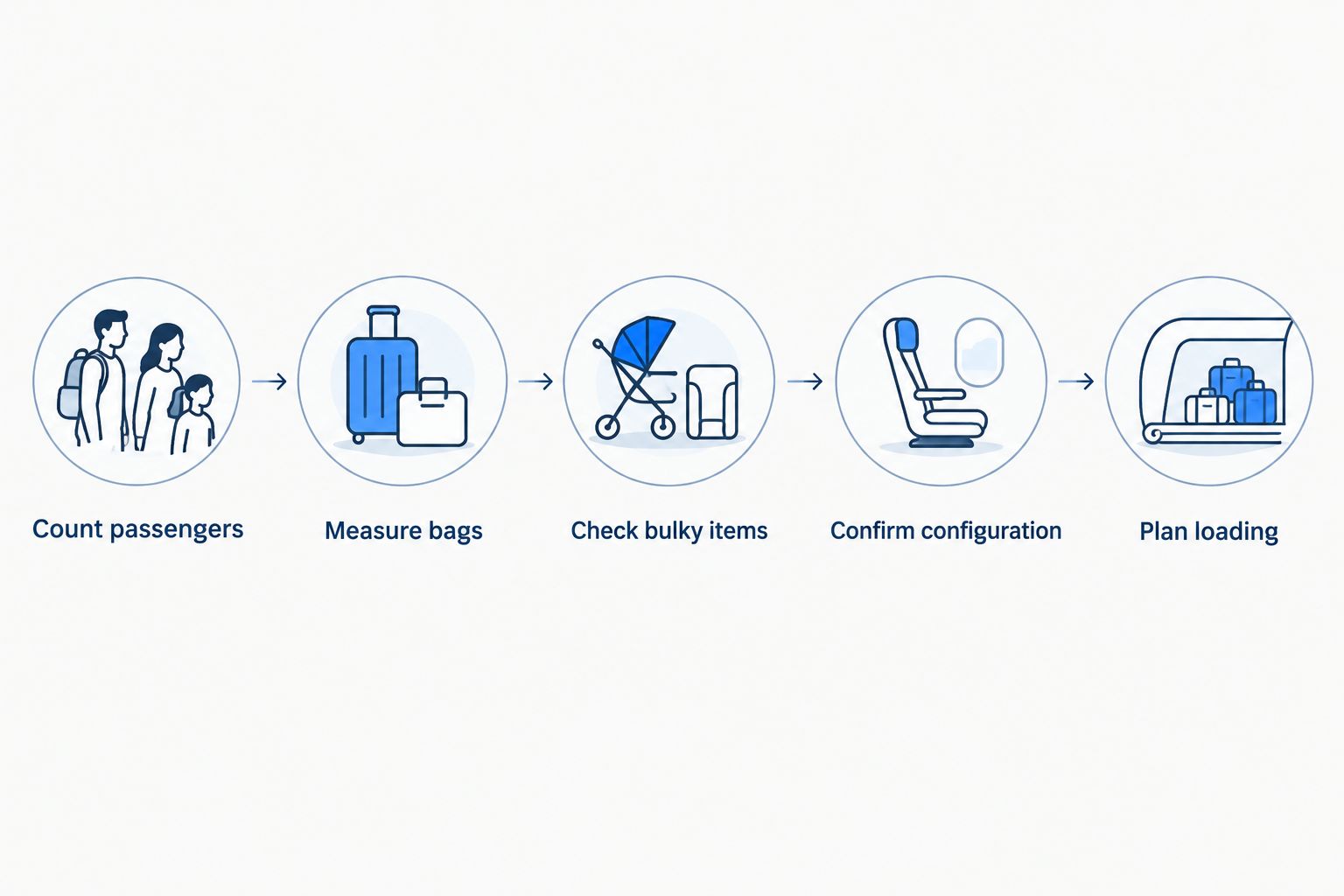
- Count passengers. Include everyone traveling from pickup to your destination. Identify the seats that must remain available and any child restraints that affect the layout.
- Measure bags. Record each packed item's length, width, and height in inches. Measure the outside edges, including wheels and handles, rather than relying on a luggage category.
- Check bulky items. Measure a stroller in its folded travel position. Add equipment cases and other unusually shaped belongings to the same inventory.
- Confirm configuration. Ask the rental team to assess the specific vehicle with your required seats upright. Share photographs alongside measurements when the shape is difficult to describe.
- Plan loading. Decide where the largest cases go and which belongings need quick access. Leave enough flexibility to reposition bags without using passenger space.
Send the complete inventory in the same message. A useful request identifies the passengers, the seats you need, each bag's packed dimensions, and any stroller or equipment. That is more actionable than asking whether the car holds “a family's luggage.”
If your plans change before departure, update the inventory. An extra passenger or a larger replacement suitcase changes the layout even when the booking dates stay the same.
Pack for access, not just maximum capacity
A successful luggage arrangement works at pickup, during the drive, and when you arrive. Before you load, separate belongings into what you need immediately and what can stay packed until your accommodation.
Keep the items you need first accessible. Avoid burying a child's essentials or a business travel bag beneath the largest cases simply because that arrangement uses every gap.
Load substantial, rigid pieces before filling smaller spaces. Use remaining room for bags that fit naturally, without forcing lids or placing belongings where they interfere with passengers. Check that seat belts and child restraints remain accessible.
Before leaving, close each compartment normally and check your visibility. If a bag prevents normal closure, rearrange the load rather than pressing the hatch against it.
Will my stroller fit with the suitcases?
A stroller fits only if its folded dimensions work alongside the luggage and required passenger seats. Measure it with the wheels, handles, and accessories in the position you will use for loading.
Treat the stroller as a main item, not leftover cargo. Test its placement alongside the largest suitcase first, then work out where smaller bags belong. Keep it accessible if you need it immediately after parking.
Can I use the advertised maximum cargo space with passengers?
Maximum cargo space is not automatically the space available with every passenger seat occupied. Check which seating arrangement a quoted figure describes before using it to plan your luggage.
For a 2026 family trip, ask about the space behind the seats your family will actually occupy. That makes the answer relevant to your journey rather than to an empty-cabin demonstration.
Choose the rental around the whole trip
The Suite Escape is best for Los Angeles Tesla rental travelers who prioritize concierge delivery and unlimited miles. Its Model Y offering sits alongside Model 3 and Cybertruck rentals, but a model name alone does not establish whether your particular luggage load fits.
The Suite Escape pairs luxury Tesla rentals with FSD (Supervised) included and has 450+ five-star reviews. FSD (Supervised) requires an attentive driver; it does not make the vehicle autonomous. Keep that driving feature separate from the practical decision about seating and luggage.
For your 2026 booking, discuss the baggage inventory before choosing the vehicle. Book for the seats and luggage you need together, then plan the delivery around your arrival. Pristine presentation and concierge ease work best when the practical details are settled first.
You can check The Suite Escape and share your passenger count, packed bag dimensions, and any bulky equipment when arranging your rental.
Plan your Model Y rental
Share your passengers, luggage dimensions, and LAX arrival plans before booking.
FAQ
How many suitcases fit in a rented Tesla Model Y?
There is no universal suitcase count, but a Tesla Model Y has 29 cu ft behind the rear seats, a 4.1 cu ft front trunk, and 71–76 cu ft with rear seats folded. Dimensions vary by model year; fit still depends on the packed dimensions of your bags, the seats your passengers need, and any stroller or bulky equipment.
Is Tesla Model Y rental luggage space enough for a family?
Tesla Model Y rental luggage space needs to be checked against your family’s actual bags and seating requirements. Assess the rear cargo area with all required passenger seats upright, then check smaller storage compartments separately.
Can I put a carry-on in the Model Y front trunk?
A carry-on fits in the front trunk only if its packed exterior dimensions fit that compartment. Include wheels and handles, and make sure the lid closes normally without pressure.
Do I need to fold the rear seats for airport luggage?
You need to fold rear seats only if your luggage requires that space and those seats are unused. Confirm the load with every required passenger seat upright before deciding on the layout.
Will a stroller and luggage fit together in a Model Y rental?
A stroller and luggage fit together only when their combined shapes work in the available cargo layout. Share the stroller’s folded dimensions and the packed suitcase dimensions with the rental team before booking.
What should I send the rental company to confirm luggage fit?
Send your passenger count, required seating arrangement, packed bag dimensions, and details of bulky equipment. Photographs help explain shapes that measurements alone do not show.
Does concierge LAX delivery guarantee my bags will fit?
Concierge LAX delivery does not establish luggage fit. Confirm the vehicle configuration and baggage layout separately when arranging your airport handoff.
One last thing
Your return load deserves its own check. Shopping bags, gifts, or an additional traveler need space even if the original airport load fitted neatly.
Photograph your working luggage layout before unloading at your accommodation. The picture gives you a reference for the return journey and shows which compartments you used. Keep the same passenger seating requirements in mind when repacking.


[…] Tesla Model Y […]